
Find Everything You
Need.



Let's Make Your Vision A
Reality
At Design Thread Studio we help women like you transform your home into a reflection of your unique style—without the stress or need for a full-time designer.
Let me share a bit about why I’m so passionate about this.
For years, I worked with high-end clients, helping them create stunning spaces. But I realized something important: many women don’t want to hire a designer full-time. They want to take the reins and create their own beautiful, personalized homes—they just need the right tools and guidance to make it happen.
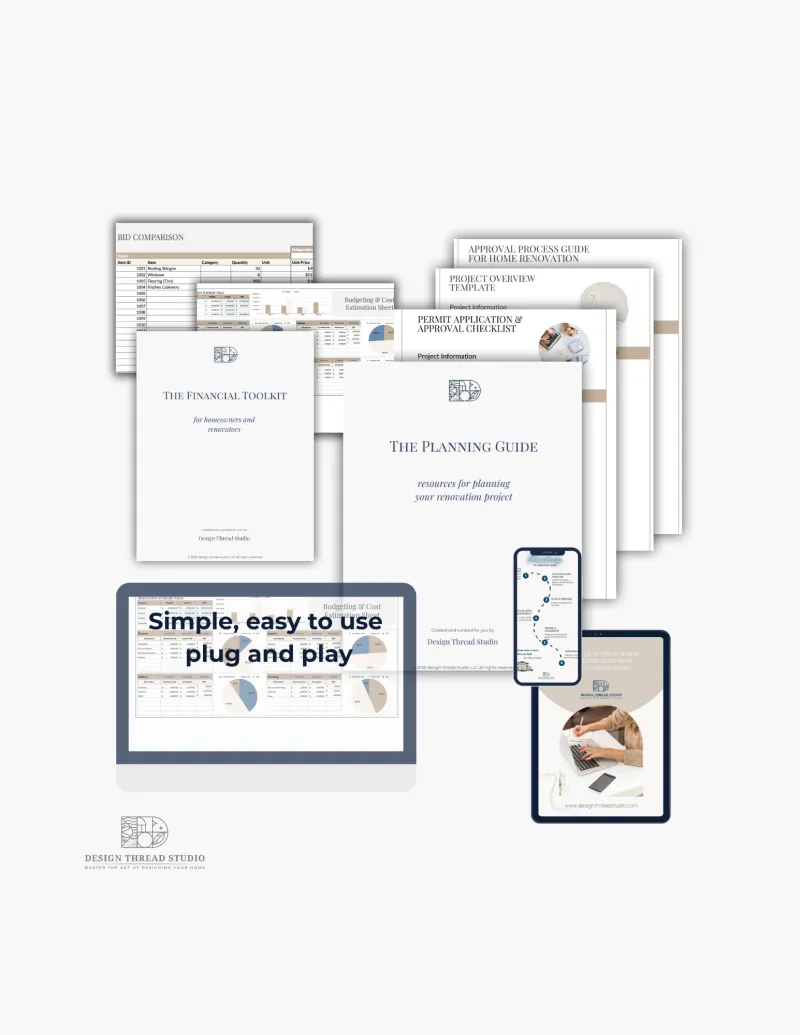
That’s why I developed a series of templates and resources designed specifically for women who want to take charge of their home projects. My step-by-step approach makes it easy to:
Plan your space with confidence.Avoid costly mistakes with proven tools.Embrace your natural sense of style to design a home you love.
The results speak for themselves:
You’ll gain clarity and reduce overwhelm. You’ll feel empowered to make design decisions. You’ll create a space that’s truly yours, without second-guessing every choice.
With Design Thread Studio’s "Measure Twice, Design Once" templates, I’ll guide you through the process of creating a home that feels timeless, elegant, and entirely
you
.
If you’re ready to bring your vision to life—stress-free and step-by-step—I’d love to help you get started.
Your Customizable Templates for Effortless Home Design
Create a Home That Reflects You—Without the Overwhelm
Discover stress-free, step-by-step solutions to design a timeless, personalized home that embraces your innate style and brings your vision to life.
Shop By Categories
Discover the perfect promotional items to elevate your brand and leave a lasting impression with our Shop by Category section. Whether you're looking for branded apparel, tech gadgets, office essentials, or eco-friendly products, we have everything you need to make a statement in your marketing campaigns.


What Client Our Says About Us

Company Name should look
for ones that are specific,
detailed, and highlight the
unique benefits of working with
the company.
Alex John Martin
Manager
Company Name should look
for ones that are specific,
detailed, and highlight the
unique benefits of working with
the company.
Alex John Martin
Manager
Company Name should look
for ones that are specific,
detailed, and highlight the
unique benefits of working with
the company.
Alex John Martin
Manager
Frequently Asked Question
Welcome to our FAQs section, where we address common questions and provide helpful answers about our services as a marketing merchandiser specializing in customizable promotional items. Whether you're new to promotional merchandise or a seasoned marketer looking to enhance your brand's visibility, our FAQs are here to provide clarity and guidance.

Can I customize the promotional items with my company logo?
Yes, we offer customization options to showcase your brand identity.
What types of promotional items do you offer?
We provide a diverse range of customizable merchandise for marketing.
What is the minimum order quantity for personalized items?
Minimum order quantities vary depending on the selected product.
How long does it take to receive my customized items?
Production times vary but are typically within 7-10 business days.
Do you offer rush shipping options for urgent orders?
Yes, we offer expedited shipping options for time-sensitive orders.
See Our Latest Blogs
Stay up-to-date with our latest insights, tips, and trends by diving into our newest blogs. Whether you're seeking industry expertise, marketing strategies, or product inspiration, our blog section is your go-to resource for valuable content.
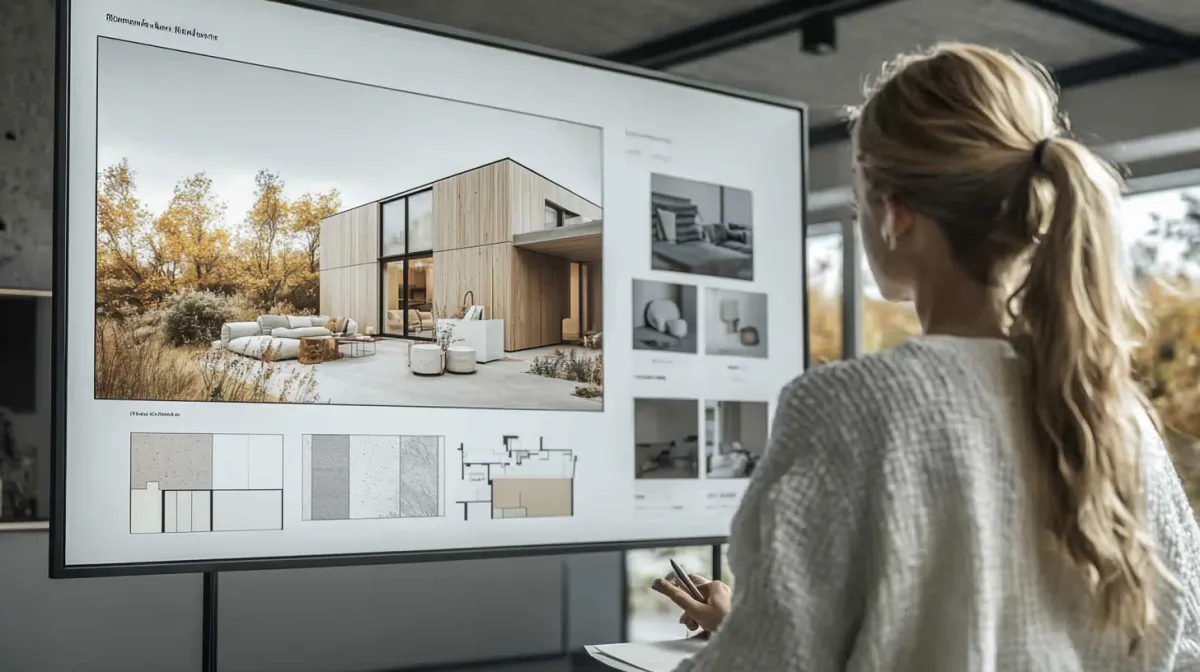
4 Ways AI Is Changing Interior Design Renovations in 2026
A designer-led look at how AI supports renovation decisions from concept to purchase.
Renovation projects don’t succeed on taste alone. They succeed on decision discipline.Once the concept is set, the work becomes protecting intent through constraint—budget, lead times, existing conditions, and the accumulation of small choices that quietly determine whether a space holds together.
For years, that responsibility lived almost entirely with the designer. You either controlled the process—thinking through options, testing them, revising, and sourcing with intention—or you absorbed the fallout when clients tried to bridge the gap themselves, armed with reference images that had no relationship to their actual space.
2026 didn’t change the value of design judgment. It changed the mechanics of applying it.
The trained eye still leads: proportion, restraint, continuity, and an instinct for what will survive real use. What’s different is the ability to pressure-test ideas earlier, preserve the concept longer, and move from direction to specification with less friction.
At Design Thread Studio, designer-trained AI supports the process—so decisions get cleaner, timelines get tighter, and the vision stays intact.
This isn’t about replacing taste. It’s about reducing noise, compressing feedback loops, and keeping intent intact from prompt to purchase.
1. AI Closes the Gap Between Inspiration and Execution
Mood boards were never the problem. The gap between inspiration and execution was.
Clients could assemble a beautiful collage—velvet seating, oak floors, warm metals—and still end up with a room that didn’t resolve. The sofa didn’t clear the entry. The flooring fought the trim. The fixtures were discontinued, delayed, or suddenly outside the budget.
Early generative AI widened that gap. It produced interiors that looked convincing at first glance, then fell apart under scrutiny: impossible junctions, incoherent lighting, furniture that couldn’t exist.
In 2026, the strongest interior design AI tools are constraint-led and commerce-aware. They work best when anchored to:
Actual spaces:scale, circulation, and fixed conditions
Real products:verified dimensions, finishes, and availability
Intentional substitutions:same feeling, adjusted cost, intact concept
The win is no longer a compelling image. It’s a plan that survives contact with reality.
2. AI Changes How Designers Set Direction
Prompting in 2026 functions less like experimentation and more like creative direction.
The difference between a generic output and a useful one is clarity—especially around constraints.
A designer-grade prompt accounts for:
Context + Constraints + Mood + Function
Instead of:
“Modern kitchen with island”
A usable direction sounds more like:
“Galley kitchen in a 1920s home. Maintain existing plumbing. Warm modern with Scandinavian restraint: light oak, matte black, creamy whites, quiet stone. Seating for three, durable surfaces, concealed waste.”
That’s not verbosity. That’s design thinking translated into language.
Equally important: using feeling words with intent. Homes are lived environments, not spec sheets. Words likegrounded, calm, collected, bright but warmshape contrast, lighting softness, and material mix. This is where outputs stop behaving like renders and start behaving like rooms.
3. AI Supports Iteration Without Resetting the Concept
The first output is rarely finished. That’s expected.
Design happens through refinement—without dismantling the entire premise.
In 2026, the baseline expectation is the ability to edit within a locked concept:
swap a rug without rewriting the room
adjust lighting without shifting layout
test variants without losing proportion or rhythm
This mirrors professional practice: isolate decisions, protect the whole.
When things break—and they still do—designers simplify, regenerate locally, and move on. Mirrors, cords, layered lighting, and reflections remain challenging. The image is treated as a draft, not a verdict.
AI doesn’t remove iteration. It makes iteration less expensive and less disruptive.
4. AI Turns Visual Direction Into Purchase Reality
This is where many platforms still fail.
A beautiful image without product logic is visual entertainment.
A functional renovation workflow allows designers and clients to:
identify real or near-real products
verify dimensions and finishes
compare price tiers
save shoppable lists by room
Stronger systems offer intelligent substitutions that preserve the design language while adjusting cost or availability.
This is where AI stops being a visual tool and starts acting like infrastructure.
Where AI Actually Pays Off
The value isn’t speed for speed’s sake. It’s mistake prevention.
One wrong decision—a sofa return, a mis-scaled table, a finish that fails under artificial light—often costs more than the tool that could have prevented it.
AI doesn’t replace design judgment. It reduces friction around it.
Common Pitfalls That Still Require a Designer
Structural overreach
AI can remove walls visually. That doesn’t make it appropriate. Structure still requires licensed review.
Material naïveté
No system can feel fabric, predict wear, or read undertones under site lighting. Samples remain essential.
Overloading direction
Too many priorities dilute outcomes. Lock layout first. Refine by region.
Editorial bias
AI defaults to clean, styled spaces. Real homes need durability, storage, and forgiveness.
Why Design Judgment Still Leads
AI is capable. It is not accountable.
Design judgment protects:
proportion and scale
continuity across spaces
budget allocation that actually changes outcomes
livability over novelty
risk management
The most effective model in 2026 is not AIinstead ofa designer. It’s AIin service ofone.
Tools handle repetition. Designers protect intent.
When AI Doesn’t Deliver
If results feel generic, it’s usually because:
the space wasn’t properly documented
the direction lacked constraint
iteration was skipped
Design is still decision-making. Better tools simply make better decisions easier to reach.
Conclusion: Clarity Over Guesswork
Interior design in 2026 is less gated, not less skilled.
Designers can test ideas earlier, move through decisions with evidence instead of adrenaline, and preserve intent longer without slowing the process.
Type-the direction.
See-the implications.
Tweak-with control.
Buy-with confidence.
Not by luck. Not by aesthetics alone.
By judgment—supported by better tools.


About Us
Brand your success with personalized promotional merchandise that captivates your audience.
Copyright© 2026 Design Thread Studio - All Rights Reserved.
Facebook
Instagram
Youtube